Record #00432Space archive
Largest Known Star by Volume
Stephenson 2-18 is a provisional contender for the largest known star by volume. A radius of about 2,150 solar radii follows from published temperature and luminosity model parameters, but its distance, model assumptions and ranking remain uncertain.
ARCHIVE VISUAL / 01
NOT TO SCALE
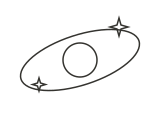
Overview
Archive NoteStephenson 2-18 lies toward Scutum, near the Stephenson 2 cluster. A 2012 observational paper reports an effective temperature around 3,200 K and log(L/Lsun) around 5.64. Applying the stellar luminosity-temperature relation to those parameters yields the often-cited radius of roughly 2,150 solar radii, rather than a directly imaged stellar edge.
Red supergiants have extended, variable atmospheres, so their effective radii depend on adopted wavelengths and physical models. Distance, interstellar extinction and uncertain membership of the nearby cluster affect luminosity and radius, preventing an unambiguous ranking from a single estimate.
Sources employ different evidentiary thresholds when naming the largest star. A specialist astronomy reference puts Stephenson 2-18 first based on model estimates, whereas Guinness favors the better-characterized WOH G64. The attribution remains unresolved.
Record history
1 Milestones- about 2150 solar radiiStephenson 2-18Current Record
Sources
Evidence & ReferencesVerification basis and limitations
ProvisionalReliable evidence supports the core facts and record candidacy; measurement models, comparison scope or final ranking remain uncertain.
Model-based record candidate
This is a provisional record candidate. Fok et al. (2012) provide modeled temperature and luminosity, from which approximately 2,150 solar radii can be derived. Star Facts explicitly ranks Stephenson 2-18 first but warns that the estimate is highly uncertain; Guinness instead favors WOH G64 among better-characterized stars. These are differing assessments, not a secure consensus.
- Measurement method
- Table 8 of Fok et al. (2012) reports Teff=3200 K and log(L/Lsun)=5.64 for St2-18. Applying the luminosity-radius-temperature relation with solar Teff=5772 K gives R/Rsun = sqrt(10^5.64) × (5772/3200)^2, approximately 2150. This is a derived estimate from published model parameters, not a directly measured stellar radius.
- Ranking confidence
- Contested
- Alternative record holders
WOH G64
Guinness favors WOH G64 among stars with well-characterized measurements, rather than accepting the largest model-derived radius unconditionally.
Comparison boundaries still under review
The 2,150-solar-radius figure depends on a 2012 model's distance and extinction assumptions and is neither a direct measurement nor an established worldwide ranking. Newer modeling in 2026 suggests lower luminosity, underscoring potential revisions. This entry does not claim a confirmed global record.
- Verification assessment
- 2026-11-07
- Last editorial review
- 2026-11-07
Current Entry identifies the current entry in this archive; it does not establish that the record is still held today.
The record value on this page is organized from the public sources above. Measurement methods may differ; JiLuDB follows the unified method described for each entry.
Public feedbackFound a data issue?If a fact has changed, the data is incorrect, or you know a more authoritative source, submit feedback.Submit feedback
Help keep the archive accurate
If a fact has changed, a value is incorrect, or you know a more authoritative source, leave a note. Feedback enters an administrator review workflow and never edits a record directly.